The best tankless hot water heater installation for most Apache Junction homes is a gas condensing unit, sized to your peak flow and installed by a licensed plumber. If your home has no gas service, a whole-house electric unit works, but it often needs an electrical panel upgrade. For a casita, guest bath, or a sink far from the main heater, a small point-of-use electric unit is the cheaper and simpler pick.
Most people searching this want three things: a local installer, a realistic price, and a clear picture of what happens on install day. Pricing is hard to pin down because gas lines, venting, and wiring differ from house to house. Elite Water Heater Services is an independent referral site, not a contractor. We connect homeowners in Apache Junction, Gold Canyon, Mesa, and San Tan Valley with independent local providers who do the work. Start at Elite Water Heater Services to explore all service options.
Below you will find what installing a tankless water heater involves and costs. Then come four setups, each with how it installs, who it suits, and what drives its price. The last section covers how to vet an installer before you approve a quote.
What tankless installation involves and costs
A standard tankless installation takes most of a day, and what you pay depends more on your gas, vent, and electrical setup than on the unit itself. These three subsections cover cost factors, the work, and sizing.
What affects cost in the East Valley
Published installed figures for tankless units vary widely, so treat any single figure as a starting point for the Apache Junction area, not a quote. Your quote moves with what your house already has. Tankless units draw far more fuel or power than a tank, so the supporting work is often the surprise.
| Cost driver | Why it changes your quote |
|---|---|
| Gas line | Whole-house gas units can burn up to 199,000 BTU per hour, so the line is often upsized |
| Venting | Condensing units use plastic vent pipe, non-condensing units need stainless steel |
| Electrical | Gas units need an outlet, whole-house electric units need several 40-amp breakers |
| Condensation drain | Condensing units need a drain line for their exhaust water |
| Permit and haul-away | Inspection fees and removal of the old tank |
Costs above are planning ranges from published installer figures, not quotes for your home — get a written itemized quote.
Do not budget for a federal tax credit. The Energy Efficient Home Improvement Credit no longer applies to equipment installed after December 31, 2025. Ask your installer about utility rebates instead.
The unit is the smaller part of the bill, because gas, venting, and electrical work decide the total.
What happens on installation day
Plan on 4 to 6 hours for a tankless job, compared with about 2 to 4 hours for a straightforward tank swap. The extra time goes to gas, venting, and wiring. Mounting a tankless water heater is the easy part. The code-compliant connections take the time.
- The installer shuts off gas, water, and power, then drains and removes the old tank.
- The new unit is mounted on a wall, often in the garage or on an exterior wall.
- The gas line is sized and connected, or the electrical circuits are run.
- The vent goes through a wall or roof, and a condensation drain is added if the unit needs one.
- Water lines connect through service valves that let you flush the unit later.
- The installer tests pressure, flow, and temperature, and arranges the inspection.
Sizing a unit for a 2,000 square foot home
Flow rate sets the water heater size you need, not square footage. A three-bedroom, two-bath house of 2,000 square feet might run two showers at 2.0 gallons per minute and a dishwasher at 1.5 at the same time. That totals 5.5 gallons per minute, so you want a unit that delivers at least 6 at your coldest-season temperature rise.
Rated flow drops as the required temperature rise grows. Ask the installer to show the math instead of quoting the number on the box.
Downsides to weigh
Tankless units cost more upfront and may need gas line or panel upgrades. Phoenix-area water is commonly cited at 15 to 25 grains per gallon, so scale builds up fast and the unit needs water heater maintenance, mainly descaling, about once a year. You may also notice a short cold gap between uses.
Savings are real but modest. The U.S. Department of Energy puts the gain at 24 to 34 percent for light users and 8 to 14 percent for heavy ones. Expect a longer lifespan, about 15 to 20 years versus 8 to 12 for a tank, as our tank vs tankless water heaters comparison explains.
1. Gas condensing whole-house unit
For most homes with natural gas or propane, a gas condensing unit is the best starting point.
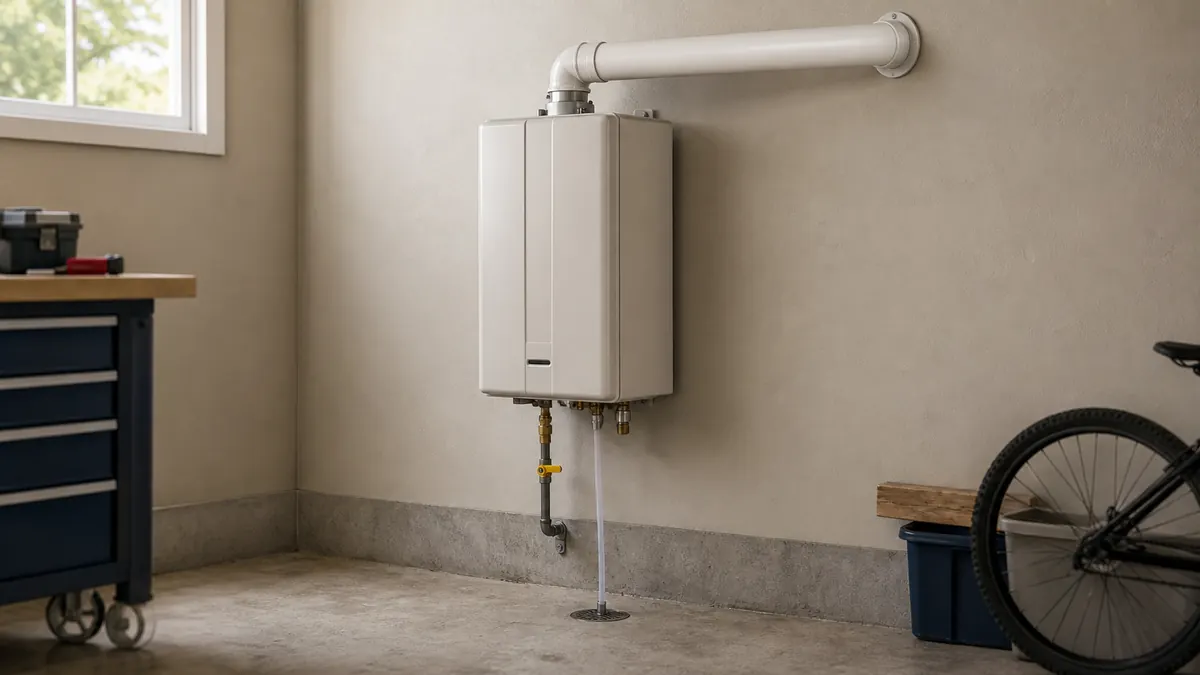
What the installation involves
A second heat exchanger pulls extra heat from the exhaust, so the vent can be plastic pipe through an exterior wall. Your installer mounts the unit on the wall, runs a gas line sized to its BTU rating, adds a condensation drain, and connects water and power. One local installer lists the Navien NPE-240A2 at 199,000 BTU and up to 11.2 gallons per minute, with a built-in recirculation pump.
Who it suits
Families that run two or more bathrooms at once get the most from this setup. A recirculation pump also speeds up hot water at distant faucets. For larger homes, installers can stage two units on one manifold. Confirm your wall or garage has room for the vent clearances.
Cost drivers and brands
Condensing units cost more than non-condensing ones but use cheaper vent pipe. The gas line upgrade is the usual extra. Navien, Rinnai, and Rheem all sell condensing models. Ask which brand the installer stocks and services, because parts and warranty handling depend on it.
If you have gas and a busy household, a condensing unit gives the most hot water for the lowest running cost.
2. Gas non-condensing whole-house unit
A non-condensing gas unit costs less to buy and fits homes where a condensation drain is hard to add.
What the installation involves
These units vent hotter exhaust, so the install needs stainless steel vent pipe instead of plastic. There is no condensation drain. The gas line, water connections, and power outlet are otherwise the same as for a condensing unit. Expect a similar day of work.
Who it suits
This setup suits homes that already have a stainless vent in place, such as a replacement of an older tankless unit. It also suits utility closets with no nearby drain. You give up some efficiency, so it makes the most sense when upfront price matters more than running cost.
Cost drivers and brands
Stainless vent pipe and fittings cost more than plastic, which narrows the price gap. Rinnai, Rheem, and A. O. Smith each offer both condensing and non-condensing gas models. Compare two written quotes that name the exact model, so you are not comparing different units.
A non-condensing unit saves money on the unit but spends part of it back on venting.
3. Whole-house electric unit
A whole-house electric unit is the fallback for homes with no gas, and it works only if your electrical service can carry it.
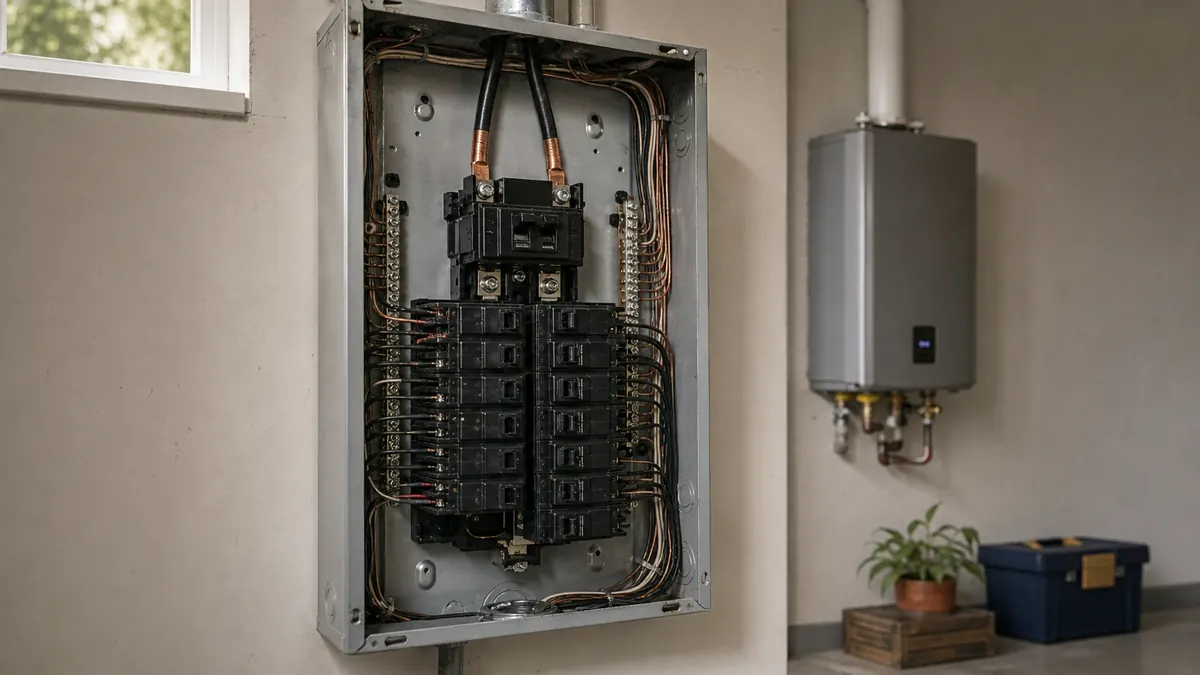
What the installation involves
There is no gas line or exhaust vent. The installer runs heavy-gauge wiring and sets 3 to 4 double-pole 40-amp breakers, according to one East Valley installer. Mounting is simple, since no vent goes through the wall. The electrical work is the whole job.
Who it suits
Choose this if your property has no gas service and you want to retire a tank. Check your panel first. Older homes and some manufactured homes may have panels that cannot carry the load without an upgrade. An all-electric home with a modern panel is the best candidate.
Cost drivers and brands
The panel upgrade, if needed, is the largest cost driver and can erase the savings. Rheem and A. O. Smith both make whole-house electric models. Ask for an electrical load calculation before you sign.
With electric tankless, the panel decides whether the project is cheap or expensive.
4. Point-of-use electric unit
A point-of-use unit heats one sink, one shower, or one small area, and it is the least expensive tankless install you can buy.
What the installation involves
The unit mounts near the fixture, often under a sink or on a closet wall, and connects to the water line and a dedicated electrical circuit. There is no venting. A plumber can usually finish it in a short visit, though the circuit may need an electrician.
Who it suits
It suits a casita, guest bath, workshop, or a sink at the far end of the house. It also helps seasonal homeowners who only use one bathroom. It will not supply a whole house. It can sit beside your main heater and cut the wait for hot water at a faraway fixture.
Cost and brands
This is the lowest-cost route by a wide margin, and cost depends mainly on whether a circuit already exists. Several major brands, including Rheem, sell compact electric models. Check the maximum flow rating against the fixture you want to serve.
Point-of-use units solve a distance problem, not a whole-house problem.
How to hire a tankless installer you can trust
Hire an installer who holds an active Arizona contractor license, puts a written itemized quote in front of you, and handles the permit.
Check license, insurance, and permits
Look up the contractor on the Arizona Registrar of Contractors website and confirm the license is active and covers plumbing. Ask for proof of insurance. Gas and venting work should be permitted and inspected, so ask who pulls the permit. A DIY install is a poor idea here, since gas, venting, and code compliance are all part of the job.
Questions to ask before you approve a quote
- Is the license active, and what is the number?
- How did you size the unit, using flow rate and temperature rise?
- Does the quote itemize gas line, venting, electrical, permit, and haul-away?
- Are service valves for flushing included?
- What do the unit warranty and the labor warranty each cover?
- Is there a fee for the estimate?
How Elite connects you with installers
Elite does not perform plumbing work. You call (480) 919-8156 or send the request form, and an independent local provider contacts you to discuss pricing, scheduling, and options, with no obligation. We may receive compensation from providers for referrals, and we are not an authorized dealer for any brand. Verify each provider's credentials before you authorize work.
A good installer shows you the math, the permit plan, and the full price before touching a wrench.
Picking your setup and getting started
If you have gas, choose a condensing unit. If you do not, price the electrical upgrade before you choose an electric unit. Use a point-of-use unit for the one faraway bathroom or casita. Whichever you pick, the quote should name the exact model and itemize gas, venting, and electrical work.
Getting two or three written quotes takes a few days and often saves more than any brand choice. When you are ready, request a tankless water heater installation referral and an independent local provider will contact you about your home.